When AI Knows Too Much: Why the Future of Data Security Is About Making Models Forget
· 24 min read · Mahendran Vasagam
Here’s something that’s been keeping me up at night.
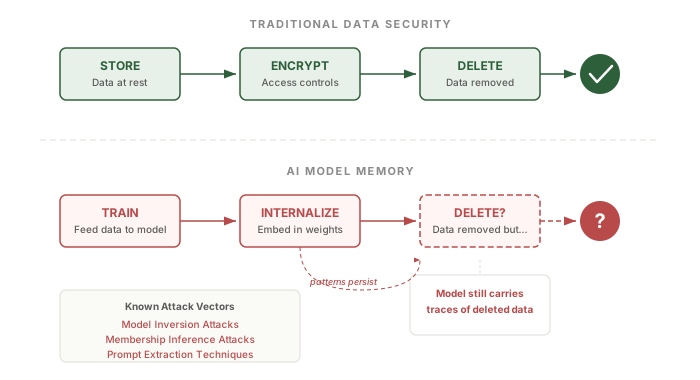
We’ve gotten remarkably good at data security over the past few decades. Encryption at rest, encryption in transit, access controls, audit logs — the whole apparatus. If sensitive data sits in a database, we know how to lock it down. And if we need to, we know how to delete it.
But AI doesn’t work like a database.
When a machine learning model — particularly a large generative model — is trained on data, it doesn’t store that data the way a SQL table would. There are no discrete rows to drop. Instead, the model absorbs information. It internalizes patterns, correlations, and statistical fragments across millions of parameters in ways that are maddeningly difficult to trace, and even harder to undo.
I keep coming back to the same uncomfortable question: if the original training data gets deleted, does the model actually forget it?
Usually, no.
The next frontier of data security isn’t about encryption. It isn’t about access control. It’s about intentional forgetting.
The Security Problem Nobody Wants to Talk About
Most of the security frameworks we rely on today were built around a fairly intuitive assumption. Sensitive data lives in a place. You protect that place with walls — encryption, permissions, monitoring. If someone says “delete it,” you delete it from that place, and it’s gone.
That assumption holds up fine for databases and file systems. It falls apart completely for AI.
When a model gets trained on customer conversations, medical records, financial logs — whatever the dataset — that information doesn’t just pass through. It becomes statistically embedded in the model’s parameters. The model didn’t memorize your data in any traditional sense. But it learned from it, and those lessons are baked in.
You might delete the original dataset. Run your compliance checklist. Feel good about it. But the model? It still carries echoes of everything it saw.
This isn’t theoretical hand-wringing, either. Researchers have demonstrated real techniques — model inversion attacks, membership inference attacks, prompt extraction — that can, under the right conditions, coax sensitive information out of trained models. Information that was supposed to be gone.
Data that no longer exists — but is still inferable. That’s the new category of risk, and our traditional security toolbox wasn’t built for it.
From “Data Protection” to “Memory Governance”
I think we need a different vocabulary for this problem. The old questions — where is the data stored? who has access? is it encrypted? — those are still important, but they’re not sufficient anymore.
The question we should be asking instead is: what is this AI system allowed to remember?
I’ve started calling this idea Security-Driven Forgetting, and the more I think about it, the more I believe it needs to be treated as a first-class security control. Not a nice-to-have. Not a checkbox for GDPR compliance. A core part of the architecture, sitting right alongside encryption and access logging.
Think about it this way: encryption protects confidentiality. Audit logs ensure accountability. Controlled forgetting? It ensures bounded retention of learned information. It’s the principle that AI systems should have explicit memory policies — the same way a human working in a classified environment has rules about what they’re allowed to carry in their head when they leave the room.
Three Kinds of Forgetting
To make any of this practical and not just philosophical, I think we need to break “forgetting” down into distinct categories. Not all forgetting is the same, and the engineering challenges are very different depending on what you’re trying to achieve.
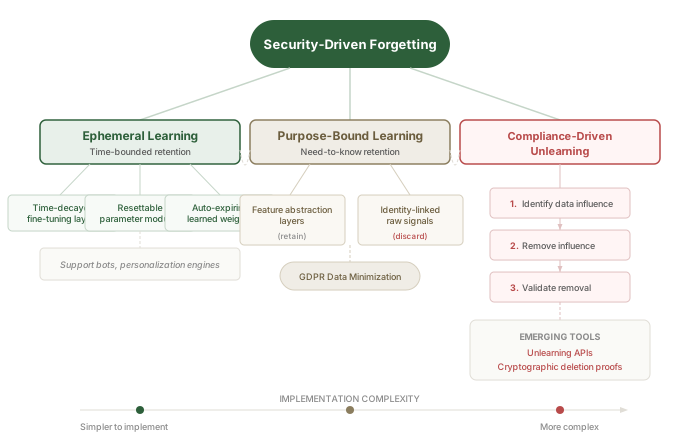
The first kind is what I’d call ephemeral learning. This is the simplest conceptually. Some models get fine-tuned on temporary data — customer support tickets from last quarter, a short-term personalization engine for a marketing campaign. That learned influence shouldn’t stick around forever. It should degrade on a schedule, or live in isolated parameter modules that can be cleanly reset when the window closes. Think of it like a whiteboard that gets erased at the end of each sprint.
The second is purpose-bound learning. This one maps directly to GDPR’s data minimization principle, and it’s more subtle. The idea is that an AI system should only retain the patterns it actually needs for its defined purpose — nothing beyond. A fraud detection model, for instance, needs to understand transaction patterns. It does not need to retain identifiable customer narratives. A diagnostic model needs prediction patterns, not personal metadata. This demands real architectural discipline: clean separation between feature abstraction layers and the raw, identity-linked signals they were derived from.
The third — and hardest — is compliance-driven unlearning. This is the big one. When a user exercises their right to be forgotten, the organization has to do three things: figure out where that person’s data influenced the model, remove that influence, and then prove that the removal actually worked. That last step is the kicker. We’re talking about emerging research in machine unlearning algorithms — techniques that can surgically adjust a model without rebuilding it entirely from scratch. I genuinely believe we’ll see “unlearning APIs” in production systems within the next few years. Audit logs for model memory. Maybe even cryptographic proofs of deletion.
We’re not there yet. But the direction is clear.
Differential Privacy Is a Start, Not the Answer
I can already hear someone typing “but what about differential privacy?” And look — differential privacy is genuinely useful. It reduces the likelihood that a model memorizes individual data points during training. That matters.
But it doesn’t solve this problem. Not fully.
Differential privacy can’t guarantee that you can erase a specific person’s influence after training is done. It can’t trace which data shaped which behavior. And it says nothing about purpose-bound retention — the idea that a model should only remember what it needs to, and nothing more.
It’s a probabilistic shield. Helpful, yes. But it’s not a memory governance framework. And we need the framework.
The Enterprise Problem That’s Already Here
This isn’t some far-off concern. Walk into any large company right now and you’ll find AI systems being spun up on internal data at a pace that would make compliance teams dizzy, if they even knew about half of it.
HR copilots fine-tuned on employee records. Legal assistants trained on case archives. Medical AI systems absorbing patient data. Customer analytics models chewing through years of transaction logs.
Now ask a simple question: if any of those datasets needed to be deleted tomorrow — due to a regulation change, a data breach, a policy update — could the models actually forget?
In most organizations I’ve talked to, the honest answer is somewhere between “probably not” and “we haven’t really thought about that.”
And this isn’t just a privacy concern. It’s a regulatory risk. A litigation risk. A reputational risk. The kind of thing that doesn’t feel urgent until a regulator asks the question you don’t have an answer to.
“Can your model forget?” may soon be as common a vendor question as “Is your data encrypted?”
Building Systems That Don’t Keep the Keys
If the old era of security was about locking doors, the next one is about not copying the keys in the first place.
There are a handful of architectural shifts that I think will define the next decade of responsible AI deployment. None of them are easy, but all of them are tractable.
Modular training pipelines. Instead of monolithic training runs where everything blends together, segment sensitive data influence into removable components. If you need to unlearn a dataset, you should be able to pull it out like removing a module, not rebuilding the whole engine.
Fine-tuning isolation layers. When you customize a model for a specific use case, keep that customization in its own sandbox. Don’t let it bleed into the base model’s parameters. If the fine-tuning needs to go, it should be a clean cut.
Data influence mapping. We need to be able to trace backwards from a model’s behavior to the datasets that shaped it. Which checkpoint was influenced by which training batch? Today, most teams couldn’t tell you. That has to change.
Memory expiry policies. Not just for raw data — for learned patterns. If a model’s behavior was shaped by data that had a two-year retention policy, the learned influence should follow the same clock.
There’s an analogy here that I find genuinely useful, even if it’s imperfect.
Humans forget. And not by accident — it’s by design. We abstract, we generalize, we let go of specifics. That’s part of what makes our intelligence efficient and scalable. We don’t walk around carrying every detail of every experience; we extract what’s useful and shed the rest.
AI systems, as they exist today, are extremely good at the abstraction part. But they were never designed to forget on purpose. Nobody built in the shedding mechanism. And until we do, we’re building systems that accumulate memory indefinitely, with no natural way to let go.
Security-Driven Forgetting is, at its core, the argument that safe intelligence isn’t just about what a system can learn. It’s about what it’s allowed to remember.
The Business Case for Forgetting
I don’t want to frame this purely as a compliance burden, because I think there’s a real competitive advantage here for organizations that figure it out early.
If you can demonstrate — actually prove — that your models can unlearn specific data, you’re in a stronger position on every front. Regulatory conversations get easier. Enterprise buyers gain trust. Legal exposure shrinks. You can deploy AI in the high-risk domains (healthcare, finance, government) where other companies hesitate because they can’t answer the hard questions.
“Can your model forget?” is going to become a vendor qualification question. I’d bet on it.
Where This Goes
Close your eyes and imagine the standard five years from now. AI models ship with retention policies baked in, the way software ships with license agreements today. Every training input carries a lifecycle tag. Enterprises run regular “memory audits” the same way they run security scans. Regulators can request — and receive — proof of unlearning.
That future doesn’t require less AI. It doesn’t even require slower AI.
It just requires AI with memory discipline.
We are entering an era where intelligence is cheap but trust is expensive. If AI systems are going to operate in healthcare, in finance, in law, in the machinery of governance, they cannot be black boxes that accumulate knowledge forever with no mechanism to let go.
The next breakthrough in AI security won’t be a bigger model.
It will be a model that knows how to forget.